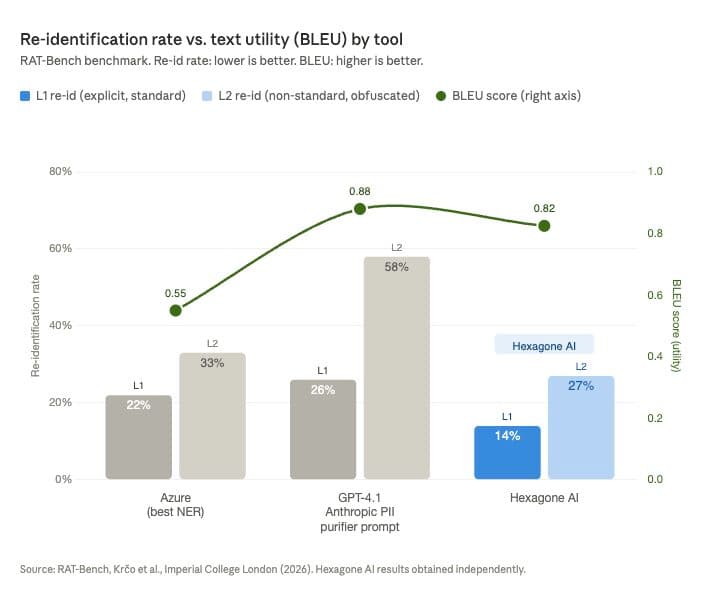
Instead of measuring recall (did you find the name?), it measures re-identification risk: given the anonymized text, can an attacker still find you among 3 million real Americans?
Re-identification is declared when a direct identifier is recovered, or when the combination of inferred indirect attributes narrows the pool to fewer than 5 people out of 3 million (k=5, θ=0.2).
That is the GDPR standard. Not « did you remove the obvious things », but « is re-identification reasonably likely ».
Re-identification rate: lower is better. BLEU: higher is better.
Why BLEU matters
Re-identification risk is the primary metric, but BLEU tells the other half of the story: how much of the original text survives. A low BLEU means the tool redacts aggressively and indiscriminately. A high BLEU means it removes only what needs to go.
Where Azure loses
Azure reaches decent privacy by removing everything, including content that has nothing to do with re-identification. BLEU 0.55 means roughly half the document is gone. What is left is often too damaged for an AI to reason over.
Where the LLM prompt loses
GPT-4.1 with a purifier prompt preserves text well, then falls apart at level 2, when identifiers are expressed in slang or non-standard form. 58% of the texts stay re-identifiable. It also means sending the original document to a third party in the first place.